



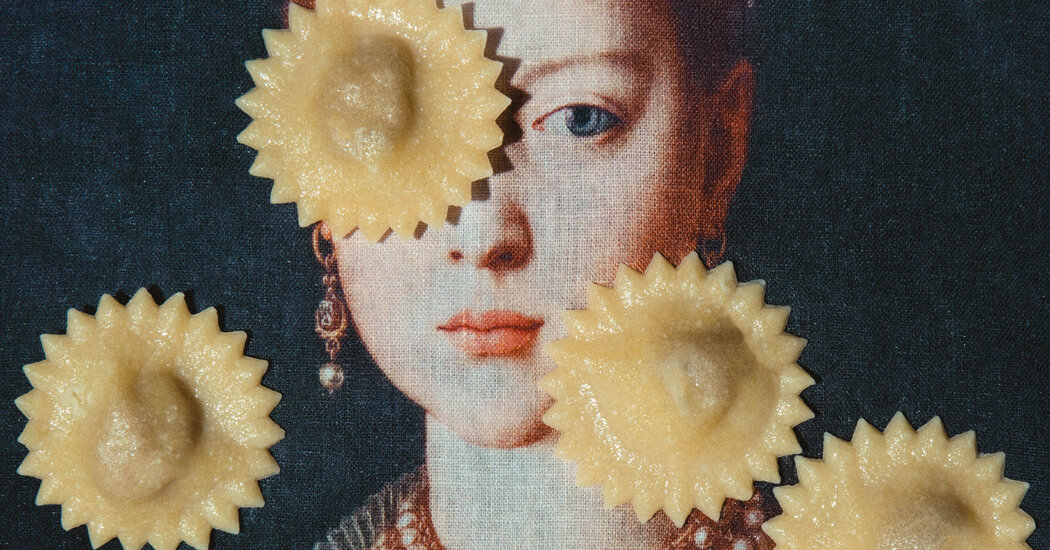
Agnolotti del plin has its own hazy back story. Centuries before the House of Savoy ruled the Kingdom of Italy, from 1861 to 1946, the dynasty controlled the Piedmont, starting in the 1600s. Bordering the Alps in the north, south and west, the region was, and remains, home to some of the peninsula’s richest and most versatile farmland, as well as immense tracts of alpine pastures, allowing for a seemingly endless supply of ingredients. When Turin served as the seat for the House of Savoy, noble families built estates throughout the countryside. Legends ascribe the dish to a chef of one of these households, a man named Angelino (a dialect translation of Angelot) who was asked to prepare a celebratory meal after the family fended off an attack on their castle. He salvaged what he could from the pantry, roasted the meats, finely chopped the vegetables and stuffed it all into pasta dough. The sauce was a simple jus made from the roasted meats.
But Ugo Alciati, the 57-year-old head chef of Guido Ristorante at the Fontanafredda wine estate about 50 miles south of Turin, is skeptical (as is everyone else I meet in the Piedmont). “It’s a story told to create a sense of mystery,” he tells me when Karima and I stop by for dinner.
His grandmother Pierina Fogliati, born at the turn of the 20th century in the nearby village of Costigliole d’Asti to the contadini, or peasant class, learned to make agnolotti del plin at home and when she was called upon as an extra hand in the kitchens of a wealthy family. The recipe she passed down to her children has much in common with the one in the cookbook “La Cucina Sana, Economica ed Elegante Secondo le Stagioni” (“Healthy, Economical and Elegant Cuisine According to the Seasons”), published in 1846 by Francesco Chapusot, the chef to the English ambassador in Turin. Chapusot instructs the home cook to roll the dough (made of flour, fresh butter, milk and eggs) into a very thin, wide sheet and paint it, using a feather brush, with a beaten egg. Then, he writes, place hazelnut-size bits of filling about an inch apart across the entire sheet, lay another sheet of dough on top, pinch the dough around the filling to make little mounds and slice around the mounds to create many small packets the width of a half-scudo (an Italian coin discontinued in the 19th century). For the filling, Chapusot advises a blend of “fatty meats,” nutmeg, Parmesan, egg, cream, parsley, garlic, salt and pepper. Fogliati’s recipe calls for escarole, as well, and a combination of veal, pork and rabbit. She served hers with a meaty ragù or a simple butter sauce. Others add the agnolotti to a broth.

RECENT COMMENTS