


When my Travel story about Saudi Arabia was published online last week, some readers bristled.
Why, they wanted to know, had The New York Times’s Travel team devoted so much time and effort to a country whose authoritarian government has committed grievous human rights abuses? Why did the kingdom deserve our attention? How much had the government paid us for our coverage?
The last question is the easiest to answer: Accepting money (or any other benefit) in exchange for coverage is strictly prohibited by The Times’s ethics guidelines. We simply don’t do it.
But in the context of Saudi Arabia, I can understand why readers wonder. While reporting the story, I learned about the incredible extent to which the Saudi government and its tourism officials have paid online influencers — those on Instagram, TikTok and YouTube — to visit the country and share overly simplified accounts of carefully curated experiences. Such an arrangement creates incentives to focus on the positive aspects of the country and leave out anything that paints a more complicated picture. And so social media is awash with glossy, one-sided content from the kingdom — which you might not realize, because the arrangements that produce it often aren’t disclosed.
In my mind, that’s one of the factors that justifies our independently reported article about Saudi Arabia’s new tourism projects: The Times is now one of the few outlets where curious readers — and potential visitors to Saudi Arabia — can find a balanced travel story that acknowledges both the country’s profound changes and its continuing complexities, including its troubling track record with human rights abuses, religious extremism and the oppression of women and L.G.B.T.Q. people.
Why was the story assigned in the first place? To put it simply: It’s newsworthy. Saudi Arabia’s $800 billion approach to drawing tourists — by building vast infrastructure for nonreligious visitors on a relatively short timetable — is unparalleled in its ambitions. What’s more, it’s part of a broader set of goals to reshape both the Saudi economy and its society at large.
We’ve been hearing about Saudi Arabia’s monumental efforts since 2019, when it began issuing its first tourist visas. This year, now that the coronavirus pandemic has waned and more of the new tourist destinations are coming online, we thought the time was right to check in on the progress.
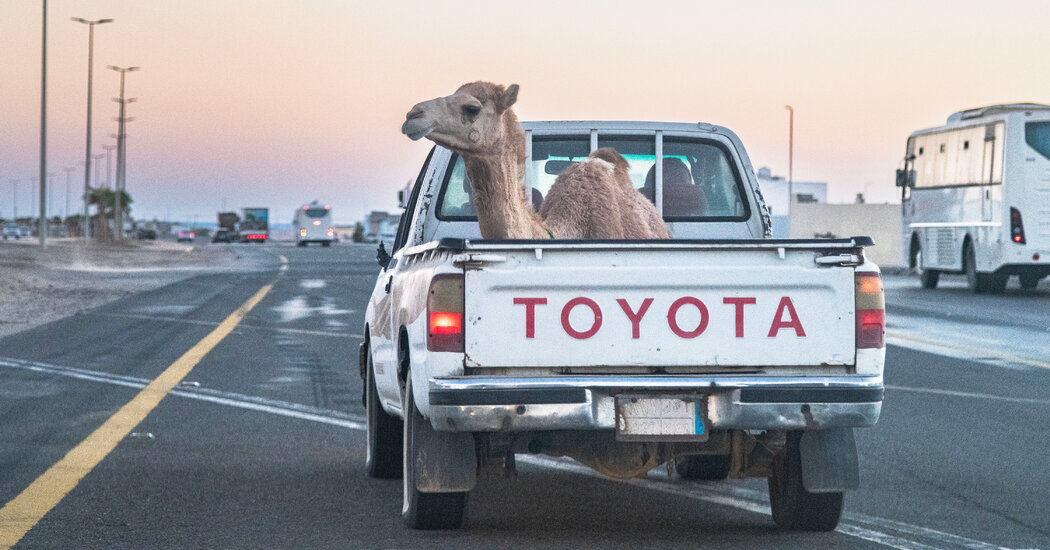
For me, that meant taking a 5,200-mile road trip — alone, without a fixer or a translator — that would bring me into contact with a broad swath of Saudi society. I wanted the article to reflect the country as a whole, not just its new construction projects. And I wanted to offer glimpses into the lives of everyday people. To achieve that, I visited several fancy resorts, but didn’t stay overnight at any of them. (Some cost well over $1,000 per night, which is way beyond the limit for a Times expense account.) Instead, I slept at communal campsites and booked rooms in budget hotels. My accommodations cost about $65 per night on average.
As for whether the kingdom deserves The Times’s attention: I’d rather say the kingdom warrants our scrutiny. To me, the word “deserve” connotes an element of moral judgment, as if a Times article were meant as a stamp of approval. And judging whether we morally agree with newsworthy events, or with the people driving them, isn’t part of the equation we use to determine what we cover. (By that logic, for example, people who committed atrocities might not “deserve” obituaries, even if they influenced the course of history.)
Ultimately, my job as a Travel journalist is neither to persuade nor dissuade anyone from visiting Saudi Arabia, nor is it to pass judgment on their society or tourism projects. My job is to explain what’s happening in the country as best I can, from the perspective of an informed traveler, and to provide cultural and historical information to help situate the present moment in a broader context.
So I attempted to do just that — in a visually immersive story that I hope offers a fair and balanced portrait of a country undergoing profound changes.
RECENT COMMENTS