


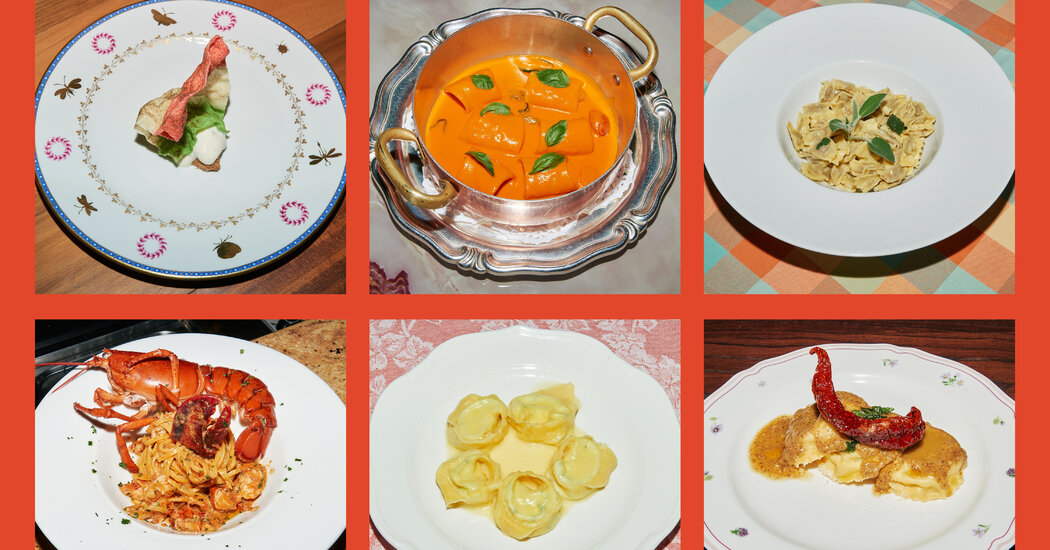
Tourists tend to flock to Macerata, a small hilltop city in the eastern part of the Marche region, for two reasons: The summer opera festival and the decidedly unsummery seven-layer baked pasta dish known as vincisgrassi. Letizia Carducci, one of the three siblings who have been running the 30-seat Osteria Dei Fiori, which opened in 1980 on a cobblestone street close to the main square, says the dish evolved from princisgras, a pasta casserole made with black truffles and prosciutto that was served to the local nobility in the 18th century. In the Marcerate province, resourceful housewives made a ragù using meat from various farmyard animals, including bones and offal; that’s the recipe that Iginia and her brother, Paolo (they cook; their sister Letizia is the maitre’d), have built on to make their vincisgrassi, which consists of duck, chicken, rabbit and a little pork. Dessert wine, vino cotto, also plays a key role: It’s added to the dough that the Carduccis knead into silk-thin pasta sheets, then used to saute the chicken and duck livers, which are stirred into the sauce at the very end. The meaty ragù covers the four bottom layers, while the top one is reserved for the nutmeg-inflected béchamel sauce. Baked in an oven, the whole thing is both earthy and luxurious, with subtle hints of smoke. Suggested wine pairing: Gàjole Verdicchio di Matelica 2021. — V.B.
61 Via Lauro Rossi
Secchi: What is vincisgrassi? I’ve never had it.
Corradin: It’s Macerata’s ancestral lasagna. One story says that it’s named for an Austrian officer named Windisch-Graetz who was stationed in Macerata province around the early 1800s.
Moyer-Nocchi: Lasagna has become a specific dish, associated with a specific place. The Maceratese prefer not to call their dish a lasagna, even though it, too, is a rich, layered pasta dish.
Palluda: When these dishes were born, there were no computers [people didn’t sit all day] and no radiators. They stayed warm with a fire, but with the food also. They expended calories to stay warm. People ate just one meal every day.
Moyer-Nocchi: Historically, you’d only eat these things once or twice a year. It’s not like you’d be picking these dishes off a menu every day. In the meantime, you’d be eating much more frugally: cabbage, beans, leafy greens.
Palluda: Somebody said to me, “Why don’t you make some of these traditional pastas lighter?” But that’s not the right way to respect the dishes. We can make the portions smaller, but you need to keep the flavor.
Photo editor: Lauren Poggi
Research editor: Alexis Sottile
Copy editor: Magnus Schaefer
RECENT COMMENTS