


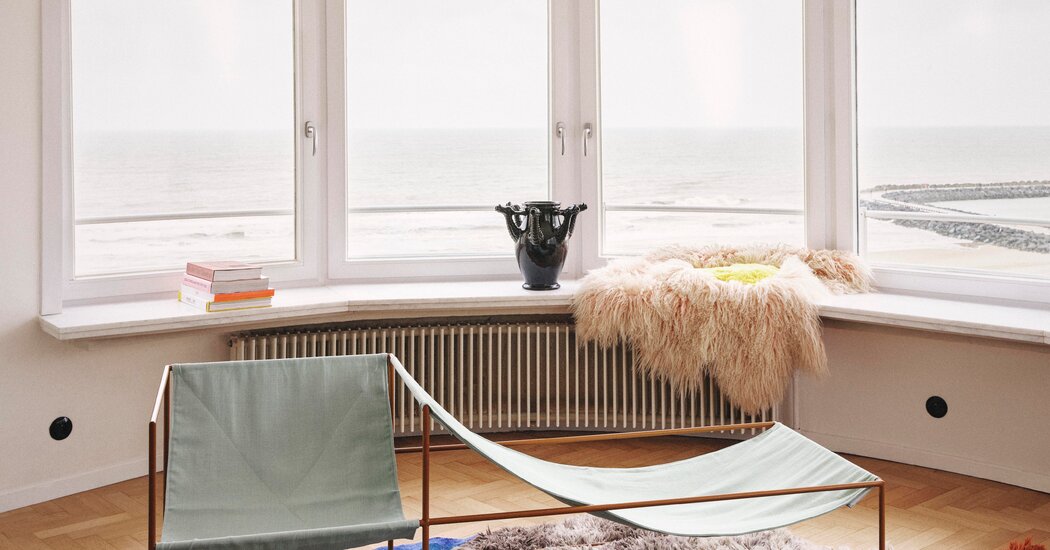
Rooms With a North Sea View
Last year, when Micha Pycke, 40, and Albane Paret, 39, bought an apartment in Ostend — a once run-down Belgian seaside town that, in recent years, has become a favorite of artists and designers — they knew they wanted the place to be, says Pycke, “something more than an Airbnb or holiday home.” Instead, the couple, who co-own the Ghent-based arts- and design-focused communications agency Club Paradis, envisioned what he calls “a new kind of space”: essentially, a gallery where guests could stay overnight. To that end, they’ve filled the 1,000-square-foot two-bedroom, which is on the eighth floor of a ’60s-era building overlooking the North Sea, with works by some of their favorite artists and designers, many of whom are also their clients. In the living room, a lacquered wood coffee table by the Dutch designer Linde Freya Tangelder’s studio, Destroyers/Builders, sits atop a limited-edition rug by the Swiss textile artist Christoph Hefti woven with images of foxes. In one of the bedrooms, a copper-colored, ruched-felt tapestry by Rooms Studio — a women-led company from Tbilisi, Georgia — hangs above a Duo seat by the Belgian team Muller Van Severen for Valerie Objects. And if you like something, you can probably take it with you; most of the pieces are for sale, and Pycke and Paret are also happy to connect guests directly with designers. Rates from about $305 a night, paradisapartment.com. — Gisela Williams
The Chefs Embracing the Earthiness of Hojicha
Hojicha — the deep brown roasted leaves and stems typically made from the Japanese green tea bancha — might lack the visual drama of now-ubiquitous matcha but, according to the pastry chefs whipping the pulverized leaves into batter and sprinkling them on cakes, that understated appearance is part of its appeal. The Los Angeles-based chef Gerardo Gonzalez, 41, who first used the tea in a guava-and-coconut custard at his now-shuttered El Rey luncheonette in New York, finds its “light, claylike color really beautiful.” Last year, for a Valentine’s Day collaboration with the downtown New York restaurant Dimes, he added it to the black sesame praline filling of crémeux tarts, which were topped with segmented citrus and lovage leaves. “The bitter, tannic notes of hojicha make something really sweet complex rather than 2-D,” he says. An Vo, 32, of the West Hollywood-based online-only bakery AV Patisserie, says she likes the tea’s “hints of cacao” and “warm, toasty caramel.” She folds hojicha powder into the batter of her spongecake, which is soaked in espresso and finished with a combination of mascarpone and whipped cream. Hojicha’s earthiness also pairs well with ice cream. Jesse, 29, and Javier Zuniga, 33, the couple behind the New York-based ice cream maker Bad Habit, say it gives a smoky depth to their baked Alaska. In Chicago, during her tenure at the bakery Brite, the pastry chef Erika Chan, 32, doubled down on the ingredient, glazing doughnuts in a slick of hojicha-milk syrup and mixing the tea into its yeasted dough. “The flavor,” she says, “reminds me of popcorn.” — Lauren Joseph
Boat Shoes Get a Spring Update, With Fresh Colors and New Shapes
A Cocktail Ring That Brings to Life a Decades-Old Sketch
Bookended by World War I and the collapse of the stock market, the 1920s were a brief and combustible period of glamorous mythmaking. Case in point: the gauzy origins of the attention-grabbing cocktail rings that many a flapper wore on her right-hand index finger, supposedly to signal to a speakeasy bartender that she was looking for a pour of the real stuff. By the late 1950s, a new generation of Hollywood starlets and Stork Club patrons had rediscovered the enormous bijoux, and the New York City-born jeweler Harry Winston, mostly known for his spectacular diamonds set in platinum, began hatching plans for colored cocktail rings of his own. Recently, the house’s designers unearthed in their archives never-used sketches he made during that era; to bring them to life, they added traditional stones like rubies, emeralds and sapphires to a confectionary explosion of modern hard-candy hues: Italian ice blue aquamarines, raspberry red spinels, purplish tourmalines. This platinum ring, with a 15-carat oval tsavorite garnet at its center, big and juicy as a lozenge, is surrounded by peridots, diamonds and pink sapphires: pure sugar shock. Harry Winston Candy ring, price on request, harrywinston.com. — Nancy Hass
Digital tech: Maiko Ando. Photo assistant: Karl Leitz. Set designer’s assistant: Victoria Novak
RECENT COMMENTS