




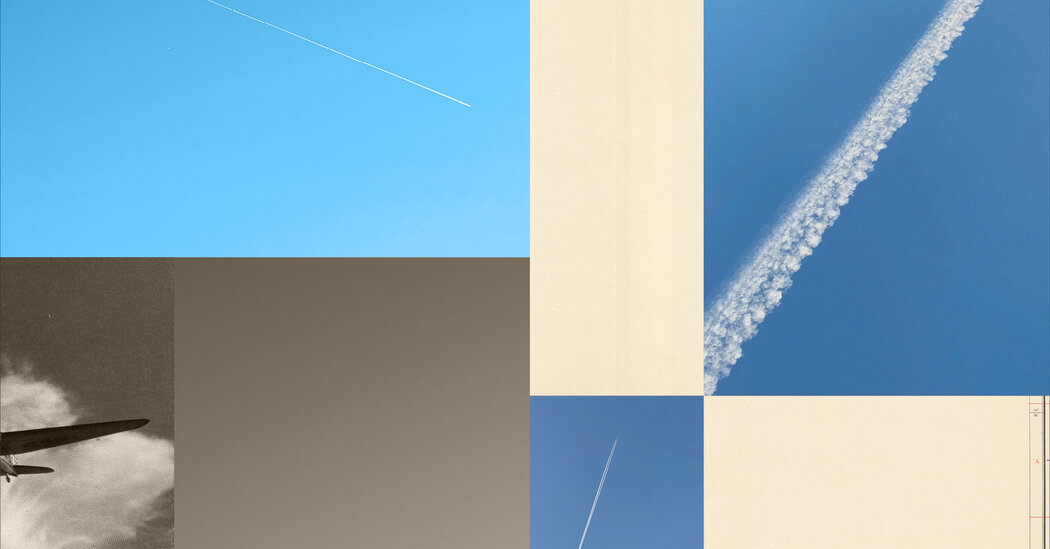
While contrails are not to be confused with the chemtrail conspiracy theory — which posits that exhaust from airplanes is laced with additives used to control the population — they are nefarious in more prosaic ways. They are now thought to contribute up to 35 percent of planetary warming caused by aviation, second only to carbon emission. Persistent spreading contrails are the most damaging, as these man-made clouds can blanket large swaths of sky, trapping heat in the atmosphere. Recent studies have suggested that the impact of contrails could be significantly reduced by pilots slightly altering their courses to avoid areas where contrails are likely to form, as they currently do to avoid patches of air where turbulence is likely. It’s possible that in a few years, contrails will be scarcer, relics of a less eco-conscious past, like aerosol cans and plastic-foam packaging.
Is it wrong to find beauty in something we know to be destructive? There’s admittedly something a little perverse about being a contrail enthusiast. For me, they conjure a sense of the sublime, a confrontation with something overwhelming and ineffable, as terrifying as it is beautiful. Traditionally, the sublime refers to encounters with the natural world, such as standing at the lip of the Grand Canyon, or witnessing the devastating power of a tsunami. I had a similar feeling on the infamous “orange day” in 2020, when the skies above San Francisco, and much of the West Coast, were dim and orange-hued because of wildfire smoke. I walked through the eerily transformed landscape of my neighborhood feeling a sense of negative awe. In that moment, I understood myself as a fragile mammal of tiny proportions relative to the scale of the planet and the climate crises that threaten it.
Contrails produce a similar effect for me. Sometimes when I look at one, I slip into an oceanic feeling — a sense of connectedness with the rest of the universe, as if a contrail is a tether between me and everything else. Unfortunately, “everything else” also includes the mass waste that we inflict upon the planet. Which is all to say: I’m not always in the mood to be charmed by contrails. On certain days, the contrails are stripped of their magic, revealed as noxious clutter. I imagine shaking the sky like an Etch-a-Sketch, ridding it of its vaporous waste.
Regardless of my mood, I can appreciate contrails as a physical record of humanity’s existence on this earth. I think about this as I observe a cross-thatching of persistent contrails, scars left by planes that have departed my little slice of the sky. They are ghostly forms reminding us of the plane that recently occupied this point in space, like the speed echo left by a cartoon character as they rush out of frame. I am here, and a moment later I’m elsewhere, but a shadow of my former self remains — for better or worse.
Kate Folk is a novelist whose forthcoming book is ‘Sky Daddy’ (Penguin Random House, 2025)
RECENT COMMENTS